Emergency Services
St John Ambulance: Transforming Safety Through Leadership
Empowering leaders, reducing risk: how a leadership-led coaching program cut task risk and injury for St John Ambulance crews.
- Client
- St John Ambulance Australia
- Sector
- Emergency Services
- Delivery
- Metro & rural teams
- Program
- Leadership-led injury prevention
Results at a Glance
Measured across participating teams over the course of the program.
46%
Average reduction in task risk
25%
Reduction in recorded injuries
30%
Increase in measured leadership skills
12%+
Improvement in fitness metrics
The Challenge
Emergency work demands physical readiness and psychological resilience, often at the same time.
St John Ambulance Australia operates in fast-paced, high-demand environments. Crews lift and move patients, manoeuvre stretchers and stair chairs in tight spaces, and work long shifts that can include confronting and emotionally demanding situations.
Manual handling is a constant source of musculoskeletal risk, and much of it happens away from a supervisor's line of sight. Traditional training alone was not enough to change how tasks were performed in the field.
St John wanted to reduce the frequency and severity of musculoskeletal injury while building the capability of its own leaders to sustain safer practices long after the program's formal phase.
Source: Safe Work Australia, Key Work Health and Safety Statistics Australia 2025.
View data table
| Industry | Serious claims per million hours worked |
|---|---|
| Agriculture, forestry & fishing | 10.0 |
| Public administration & safety | 9.6 |
| Manufacturing | 9.4 |
| Health care & social assistance | 9.4 |
| Construction | 9.3 |
| Transport, postal & warehousing | 9.0 |
| All industries average | 6.8 |
Program Focus
Five priorities shaped every part of the program.
- Reducing the frequency and severity of musculoskeletal injury
- Building leadership capability across site and crew leaders
- Reducing task-specific risk in the jobs crews perform most
- Integrating mental health and physical health into one strategy
- Continuous coaching and cultural reinforcement
How the Program Worked
Rather than training every crew member directly, EMP Onsite equipped leaders to drive change from within.
- Step 1
Measure task risk
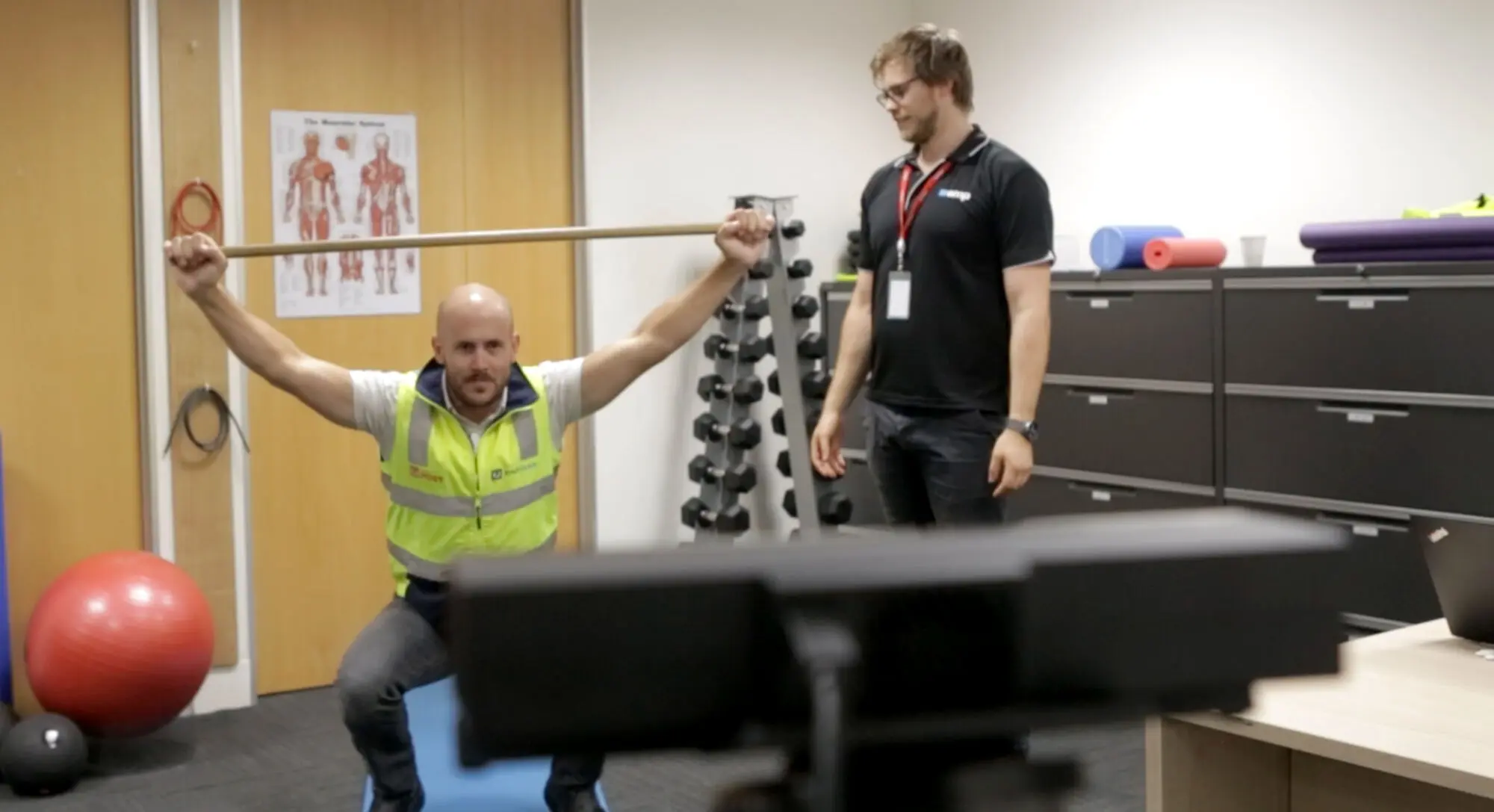
Wearable technology and AI motion analysis captured objective risk data on real tasks such as patient transfers and stair chair use.
- Step 2
Coach the leaders
Weekly engagement with site leaders focused on safety communication, coaching technique and culture.
- Step 3
Leaders coach crews
Leaders brought risk-specific coaching to their teams, with mental health support integrated into toolbox talks and learning resources.
- Step 4
Pulse-check progress
Ongoing surveys and coaching logs tracked uptake and culture, guiding where to focus next.
Flexible engagement models allowed the same cycle to run for metro and rural teams.
The Results
Average task risk fell by 46% as crews adopted safer techniques for the tasks that carried the most load, and recorded injuries fell by 25%.
At the same time, measured leadership skills increased by 30%, giving St John a stronger foundation of leaders who can identify risk, coach their teams and keep safety conversations going without external support.
Crew members also improved their fitness metrics by more than 12%, building the physical capacity that emergency work demands.
Source: St John Ambulance program data reported by EMP Onsite. Task risk measured using wearable sensor data; leadership skills measured through structured assessment.
View data table
| Metric | Change |
|---|---|
| Task risk (reduction) | 46% |
| Leadership skills (increase) | 30% |
| Recorded injuries (reduction) | 25% |
| Fitness metrics (improvement) | 12% |
Why It Works
Four principles made the program stick.
Frontline-led
Coaching and leadership influence drive safer behaviours from within the team.
Practical
An onsite, embedded delivery model increases trust and uptake.
Customised
Each team receives risk-specific coaching and planning for the work it does.
Measurable
Clear KPIs, dashboards and feedback loops show progress at every stage.
Future Applications
Enabling emergency workers through practical solutions.
By integrating evidence-based learnings and adapting to local needs, EMP Onsite's injury prevention approach delivers practical, onsite solutions that improve outcomes for emergency workers and frontline services.
The leadership-led model is designed to scale, giving emergency service organisations a repeatable way to build capability across dispersed teams.
- Reduce injury rates among emergency crews
- Support mental health and enhance job readiness
- Empower site leaders to drive lasting cultural change

Key Takeaways
- Investing in leaders multiplies the reach of injury prevention across dispersed crews.
- Objective task risk data focuses coaching on the tasks that matter most.
- Physical and mental health support work best when delivered through the same channels.
- Capability built inside the organisation sustains results beyond the program itself.
Ready to Transform Your Workplace Safety?
Talk to our team about a program tailored to your workplace. We'll show you how to reduce risk, lower claims costs, and build a stronger, safer workforce.